
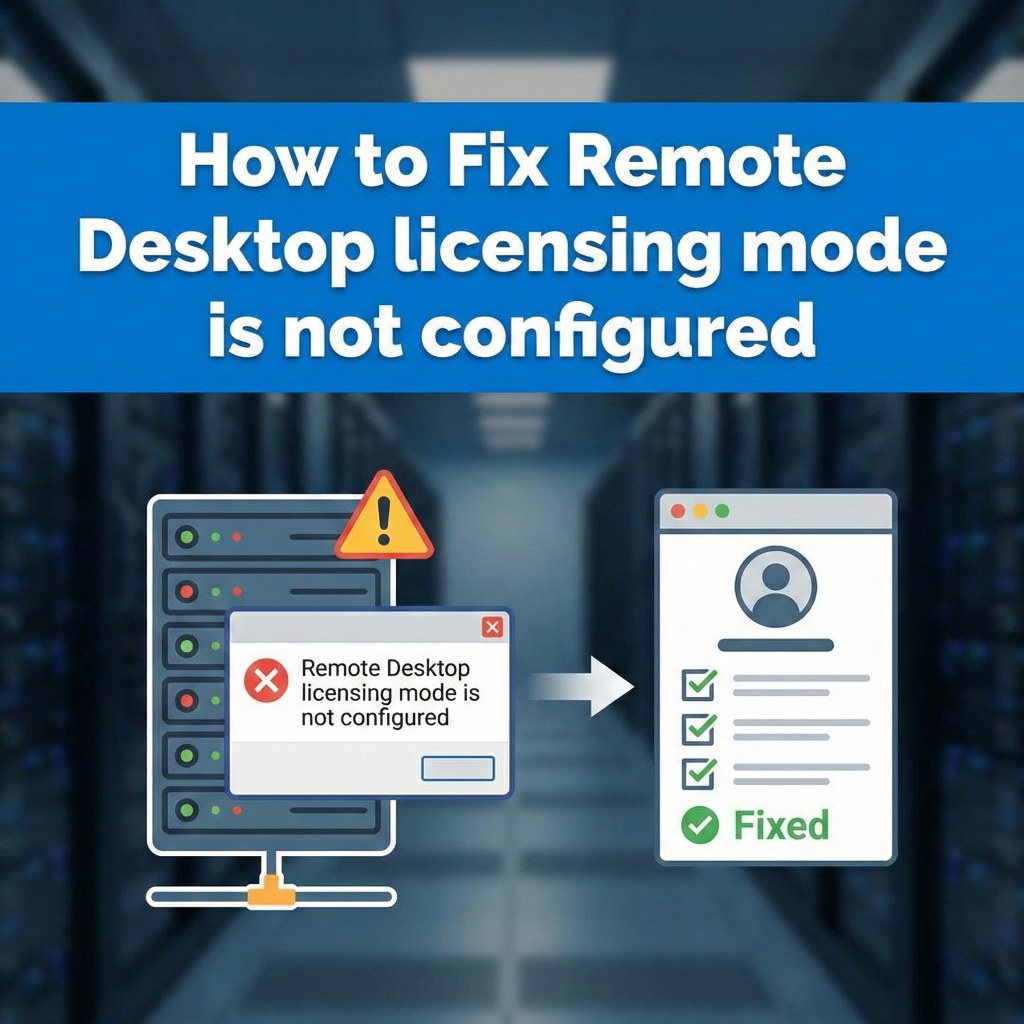
Fix: 'Remote Desktop licensing mode is not configured'
How to resolve licensing errors and grace period expirations on Windows Server.
This error typically occurs when the 120-day licensing grace period has expired, or the RD Session Host role is installed but hasn't been told which license server to query. Even if you have installed CALs, the server will block connections until the configuration is explicitly set.
⚠️ The Symptom: Users cannot connect via Remote Desktop, receiving an error stating that the "Remote Desktop licensing mode is not configured" or "The licensing grace period has expired."
Method 1: Using Local Group Policy (Recommended)
This is the most reliable method, as it forces the configuration at the system level, overriding any GUI glitches in Server Manager.
- Press Windows Key + R, type
gpedit.msc, and press Enter. - Navigate to the following path:
Computer Configuration > Administrative Templates > Windows Components > Remote Desktop Services > Remote Desktop Session Host > Licensing
- Step A: Set the Licensing Mode
- Double-click Set the Remote Desktop licensing mode.
- Select Enabled.
- Under "Specify the licensing mode for the RD Session Host server," select either Per User or Per Device (depending on your purchased CALs).
- Click OK.
- Step B: Set the License Server
- Double-click Use the specified Remote Desktop license servers.
- Select Enabled.
- Enter the IP address or Hostname of your license server (use
127.0.0.1if the license server is the same machine). - Click OK.
- To apply changes immediately, open Command Prompt as Administrator and run:
gpupdate /force
Method 2: Using PowerShell (For Standalone Servers)
If you are not using a domain or if Group Policy is not applying correctly, you can use PowerShell to force the setting via WMI objects.
1. To set the Licensing Mode:
Run the following command (Replace 4 with 2 for "Per Device" mode):
$RDS = Get-WmiObject -Class Win32_TerminalServiceSetting -Namespace "root\cimv2\terminalservices"

$RDS.ChangeMode(4)
(Note: 2 = Per Device, 4 = Per User)
2. To set the License Server:
Run the following command (Replace your-server-name with your actual server name or IP):
$RDS = Get-WmiObject -Class Win32_TerminalServiceSetting -Namespace "root\cimv2\terminalservices"

$RDS.SetSpecifiedLicenseServerList("your-server-name")
How to Verify the Fix
Once you have applied the settings, you should verify that the server recognizes the configuration.
verification: Open Server Manager, go to Tools > Remote Desktop Services > RD Licensing Diagnoser. You should see 0 errors, and the "Licensing Mode" should clearly state your selection.
Related Posts
How to configure “Licensing Mode” and “License Server to Use” on a Windows Server?
Configuring RDS Licensing Mode and License Server A guide for Windows Server 2016, 2019, 2022, and 2025. Configuring the Remote Desktop Services (RDS) licensing mode and license server on a Windows Server is a critical step for allowing more than two concurrent remote connections. The process can be done through Server Manager, Group Policy, or…
Everything you need to know about Microsoft RDS CALs
Everything you need to know about Microsoft RDS CALs A complete guide to Remote Desktop Services Client Access Licenses. What are Microsoft RDS CALs? RDS CALs (Remote Desktop Services Client Access Licenses) are a type of license required for a user or device to connect to a Windows Server running the Remote Desktop Session Host…
How to Remove or Delete all RDS CALs from a Windows Server?
How to Delete All RDS CALs from Windows Server A guide for resetting licensing on Windows Server 2016, 2019, and 2022. The process for deleting all Remote Desktop Services (RDS) CALs from a Windows Server can be done through a few different methods. The most reliable method is to rebuild the license database. ⚠️ Warning:…
How to revoke Per-Device RDS CALs on a Windows Server?
Revoking Per-Device RDS CALs Understanding the complexities of revoking Client Access Licenses in Windows Server. Revoking per-device Remote Desktop Services (RDS) Client Access Licenses (CALs) can be a complex and often misunderstood process in a Windows Server environment. The key takeaway is that direct revocation of a single per-device CAL is not always possible or…